Peptide therapy has become one of the most talked-about tools in regenerative and aesthetic medicine, and the “Glow Peptide Stack” is one of the most requested protocols we hear about at our Irvine clinic. It pairs a handful of well-studied peptides to work on skin quality, inflammation, and cellular repair at the same time, rather than treating each concern separately.
But 2026 has also been the most eventful year in this field’s regulatory history. If you read about this stack anywhere else, there’s a good chance the article predates a major FDA decision that changed what’s actually legal to prescribe right now. We’ll walk through both: what the stack is, and where things genuinely stand as of this month.
What Is the Glow Peptide Stack?
A glow peptide stack combines a few short-chain amino acid peptides, the body’s own signaling molecules, to support collagen production, calm inflammation, and speed up cellular repair at once. Rather than treating skin, energy, and recovery as separate problems, the stack works on the shared biological pathway underneath all three: how efficiently your cells communicate and rebuild.
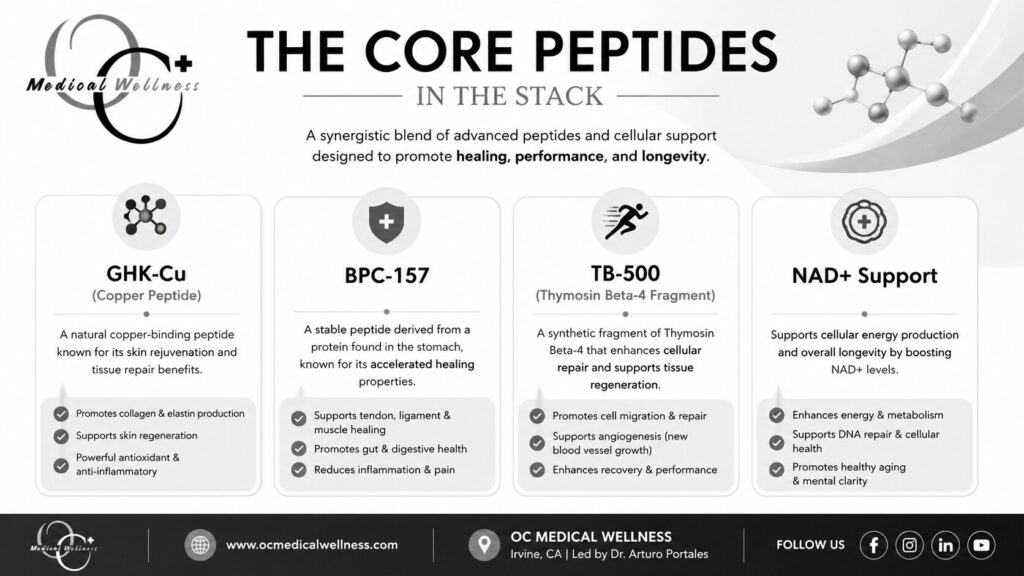
The most commonly discussed combination includes GHK-Cu, BPC-157, and TB-500, sometimes paired with NAD+ support for cellular energy. If you’re newer to this category of medicine generally, our guide on what peptide therapy is covers the basics of how peptides differ from hormones and traditional pharmaceuticals.
The Core Peptides in the Stack
GHK-Cu (Copper Peptide)
GHK-Cu is a naturally occurring copper-binding peptide studied for its role in collagen and elastin synthesis, wound healing, and antioxidant activity in skin tissue. It’s the component most directly tied to the “glow” in glow peptide stack, supporting firmer, more elastic-looking skin as natural collagen production slows with age.
BPC-157
BPC-157 is a peptide derived from a protein found in gastric juice, studied in preclinical research for its role in tissue repair, gut healing, and modulating inflammation. It’s one of the most requested peptides in regenerative medicine, and, as covered below, one of the two compounds at the center of this year’s regulatory changes.
TB-500 (Thymosin Beta-4 Fragment)
TB-500 is studied for its role in cell migration and tissue regeneration, and is often paired with BPC-157 for a broader recovery effect, one peptide supporting cell signaling and migration, the other supporting inflammation control and localized repair.
NAD+ Support
Some protocols pair the stack with NAD+-supporting therapies, since mitochondrial energy production underlies how efficiently the body can actually carry out the repair these peptides are signaling for. We offer NAD+ support as part of our broader peptide therapy program, often alongside hormone optimization for patients focused on energy and vitality.
The 2026 FDA Regulatory Update (Read This Before Anything Else)
This is the part most articles on this topic are missing, and it materially changes what a licensed clinic can legally offer right now.
The background: In September 2023, the FDA placed nineteen peptides, including BPC-157 and TB-500, into “Category 2” of its 503A bulk drug substances policy, citing safety concerns. Category 2 status means licensed compounding pharmacies are legally barred from preparing these substances for patients, regardless of physician prescription.
February 2026: HHS Secretary Robert F. Kennedy Jr. announced that roughly 14 of those 19 peptides, including BPC-157 and TB-500, were expected to move back toward legal compounding status.
April 2026: The FDA formally removed BPC-157, TB-500, CJC-1295, and several others from Category 2. Importantly, this did not place them into Category 1 (the list of substances pharmacies can legally compound). It left them in a regulatory gray zone, no longer explicitly prohibited, but not yet authorized either.
July 23–24, 2026: The FDA’s Pharmacy Compounding Advisory Committee (PCAC) met and voted on seven peptides being considered for the Category 1 list. BPC-157, TB-500, KPV, MOTS-c, Semax, and Epitalon all received favorable recommendations; only DSIP (emideltide) was voted down.
What that means today: A favorable PCAC vote is a recommendation, not a rule change. The FDA still has to complete formal rulemaking, a Notice of Proposed Rulemaking, a public comment period, and a Final Rule, before compounding pharmacies can legally prepare BPC-157 or TB-500 again. That process typically takes eight months to two years. As of this writing, BPC-157 and TB-500 are not yet legally compoundable, even though the regulatory direction is favorable.
GHK-Cu sits on different footing entirely, it’s widely used in topical and cosmetic formulations and was never part of the Category 2 restriction, so it isn’t affected by this timeline.
What this means for you: Any clinic describing a specific BPC-157 or TB-500 protocol as currently available should be able to explain exactly how they’re sourcing it and under what legal pathway. At OC Medical Wellness, Dr. Portales and our team track this FDA process directly and will walk you through what’s currently available, what’s pending, and what a compliant protocol looks like for your specific goals.
Benefits Associated With the Stack
- Skin repair and collagen support — GHK-Cu’s role in signaling fibroblasts toward collagen and elastin production is the best-studied part of this stack.
- Inflammation modulation — BPC-157 and TB-500 are both studied for influencing inflammatory pathways relevant to tissue repair.
- Recovery support — the combination is often discussed in the context of recovery from exercise, minor injury, or post-procedure healing, which is part of why it comes up frequently alongside our wound care services.
- Cellular energy — when paired with NAD+ support, patients often report improvements in overall energy tied to mitochondrial function.
It’s worth being direct here: most of this evidence comes from preclinical and early-stage research rather than large human trials. That’s part of why physician oversight matters separating what’s well-supported from what’s still emerging.
How Peptide Therapy Is Typically Administered
Peptides can be delivered several ways, though not all are appropriate for every compound or every patient:
- Injection (subcutaneous or intramuscular), administered under medical supervision
- Topical formulations, most common for GHK-Cu specifically
- Oral formulations, though bioavailability is generally lower than injectable routes
Dosing, frequency, and any cycling schedule should be set individually by your physician based on your health history, goals, and, for compounds still working through FDA rulemaking, current legal availability. We’d rather have that conversation directly with you than publish a generic protocol that may not reflect what’s actually appropriate for your situation.
Who Should Consider It, and Who Shouldn’t
Peptide therapy is generally explored by adults interested in skin health, recovery support, or broader anti-aging and regenerative goals, often alongside services like Morpheus8 for skin, or stem cell therapy for more comprehensive regenerative protocols.
It’s generally not appropriate for:
- Pregnant or breastfeeding individuals
- People with active cancer or uncontrolled chronic illness
- Anyone on medications that could interact with cellular growth pathways
If you’re weighing peptides against other options for muscle recovery or performance, our comparison of peptides vs. steroids breaks down how the two categories actually differ.
Why Physician Supervision Matters More Than Ever Right Now
With BPC-157 and TB-500 sitting in an active regulatory transition, this is exactly the kind of moment where working with a licensed, informed physician matters most. Dr. Arturo Portales is a board-certified osteopathic physician and Fellow of the American Academy of Anti-Aging Medicine with over 20 years of experience in regenerative and functional medicine, and our team actively monitors FDA rulemaking on these compounds rather than relying on outdated information.
FAQs
Is the Glow Peptide Stack legal right now?
GHK-Cu is broadly available. BPC-157 and TB-500 received a favorable FDA advisory committee recommendation in July 2026 but are not yet legally compoundable, requiring completed FDA rulemaking, which is still in progress.
How long does it take to see results?
Reported timelines vary by individual and protocol. Some patients report changes in skin quality within a few weeks, while deeper recovery benefits typically take longer and depend on the specific goals being addressed.
Can this be combined with other treatments?
Peptide therapy is often discussed alongside hormone optimization, NAD+ support, or aesthetic treatments like Morpheus8, but any combination should be reviewed by your physician first.
What are the risks?
Reported mild effects include injection site irritation, headache, or temporary fatigue. Because BPC-157 and TB-500 are still working through FDA rulemaking, sourcing and quality control matter more than usual, this is not a category where you want to self-source from unregulated sellers.
Where can I learn more before booking a consultation? Our guides on what peptide therapy is and which peptides support weight loss cover related protocols if you’re exploring options beyond the glow stack specifically.