
If you’ve ever felt a wave of heat rush from your chest to your face in the middle of a meeting, woken up drenched in sweat at 3 a.m., or found yourself fanning a menu at dinner while everyone else reaches for a sweater, you already know what a hot flash feels like. What you may not know is why it’s happening, how long it’s likely to last, or which treatment options actually work versus which ones are just wellness-aisle marketing.
At OC Medical Wellness in Irvine, we see this conversation almost every day. Hot flashes are the single most reported symptom of the menopausal transition, and for many women they’re also the most disruptive, interrupting sleep, work, and simple day-to-day comfort. This guide breaks down exactly what causes hot flashes, how to recognize the symptom pattern, when they signal something other than menopause, and the full range of medical, hormonal, and lifestyle treatments available today, including the options our team offers under the direction of Dr. Arturo Portales.
Key Takeaways
- A hot flash is a sudden sensation of heat, usually centered on the face, neck, and chest, often followed by sweating and sometimes chills.
- Declining and fluctuating estrogen during perimenopause and menopause is the most common cause, though thyroid conditions, certain medications, and other health issues can also trigger them.
- The average duration of hot flashes is more than seven years, and some women experience them for a decade or longer.
- Treatment ranges from lifestyle adjustments and nonhormonal medications to bioidentical hormone replacement therapy (BHRT), the right choice depends on your symptom severity, health history, and personal goals.
- Hot flashes that are frequent, severe, or paired with other symptoms deserve a real medical evaluation, not just guesswork with supplements.
What Is a Hot Flash?
A hot flash is a sudden, intense feeling of warmth that spreads through the upper body, typically starting in the chest and rising through the neck and face. It’s the body’s thermoregulatory system misfiring, and it can last anywhere from 30 seconds to five minutes. Many women describe it as an internal furnace switching on without warning, sometimes followed by visible flushing, a racing heartbeat, and a cold, clammy feeling once the heat subsides.
When this same sensation happens during sleep, it’s called a night sweat, and it’s one of the leading reasons perimenopausal and menopausal women report chronic sleep disruption.
Hot flashes are not dangerous in themselves, but they can meaningfully affect quality of life, and research has linked frequent, severe hot flashes to a somewhat higher long-term risk of cardiovascular issues and bone density loss, which is one more reason they’re worth addressing rather than “toughing out.”
What Causes Hot Flashes?
Hormonal Changes During Perimenopause and Menopause
The overwhelming majority of hot flashes are tied to the natural decline in estrogen that occurs as the ovaries slow hormone production during perimenopause and menopause. Researchers believe that dropping estrogen levels affect the hypothalamus, the part of the brain that acts as your internal thermostat. When the hypothalamus becomes more sensitive to small shifts in body temperature, it can mistakenly sense that the body is overheating and trigger a rapid cooling response: blood vessels near the skin dilate, heart rate increases, and you sweat, all in an effort to release heat that was never actually there.
This is why hot flashes are considered a vasomotor symptom, and clinicians often refer to them collectively (along with night sweats) as VMS.
Other Medical Causes
While menopause is by far the most common cause, hot flashes can occasionally stem from other conditions, including:
- Thyroid disorders, particularly hyperthyroidism
- Certain medications, including some antidepressants, opioids, and cancer treatments
- Hormone-sensitive cancer treatments, such as anti-estrogen therapy for breast cancer or androgen deprivation therapy for prostate cancer
- Primary ovarian insufficiency, where ovarian function declines before age 40
- Rarely, tumors affecting the endocrine system
If hot flashes appear outside the typical perimenopausal age range, or arrive alongside unexplained weight changes, rapid heartbeat, or other new symptoms, it’s worth ruling out a non-hormonal cause with bloodwork rather than assuming it’s “just menopause.”
Risk Factors That Make Hot Flashes More Likely or More Severe
Not everyone going through menopause experiences hot flashes the same way. Several factors are associated with more frequent or intense episodes:
- Smoking — nicotine use is strongly linked to more frequent hot flashes
- Higher body mass index (BMI) — excess body fat can affect how the body regulates and retains heat
- Race and ethnicity — research consistently shows Black women report hot flashes more often and for longer durations than women of other racial groups, while Asian women tend to report them least frequently
- High stress levels or anxiety
- Diet triggers — caffeine, alcohol, and spicy food are commonly reported triggers, though sensitivity varies by individual
Hot Flash Symptoms: What They Actually Feel Like
Recognizing the full symptom pattern helps you describe what you’re experiencing accurately to a provider, and helps you distinguish a hot flash from anxiety, a panic attack, or a fever.
A typical hot flash may include:
- A sudden sensation of heat spreading through the chest, neck, and face
- Visible skin flushing or blotchy redness
- A rapid or pounding heartbeat
- Sweating, most often across the upper body
- A chilled, clammy feeling as the flash fades
- A brief sense of anxiety or unease during the episode
Frequency and duration vary widely from person to person. Some women experience a few hot flashes a week; others have multiple episodes per day. Most individual hot flashes last between one and five minutes. On average, women deal with hot flashes for more than seven years, and a meaningful subset continue experiencing them for a decade or more, which is exactly why “just wait it out” isn’t a realistic treatment plan for most people.
Hot Flashes vs. Night Sweats vs. Anxiety: Quick Comparison
| Symptom | Hot Flash | Night Sweat | Anxiety/Panic Episode |
| Timing | Any time, day or night | During sleep | Often tied to stressor, but can occur anytime |
| Core sensation | Sudden heat, then chill | Waking drenched in sweat | Racing thoughts, chest tightness, dread |
| Duration | 1–5 minutes | Minutes, disrupts sleep | Minutes to longer |
| Trigger pattern | Hormonal, dietary, stress | Same as hot flashes | Psychological/situational triggers |
| Heart rate | Often elevated | Often elevated | Elevated, with emotional distress |
When to See a Doctor About Hot Flashes
You don’t need to wait until hot flashes become unbearable before getting evaluated. It’s worth scheduling a visit if:
- Hot flashes are disrupting your sleep, work, or daily activities
- They started before age 40 (a possible sign of primary ovarian insufficiency)
- They’re accompanied by unexplained weight loss, rapid heartbeat, or persistent fatigue
- Over-the-counter approaches and lifestyle changes haven’t helped
- You want to discuss whether hormone therapy is appropriate for your health profile
A proper evaluation typically includes a review of your symptom pattern, menstrual history, and, when indicated, bloodwork to check hormone and thyroid levels. This is exactly the kind of root-cause, whole-person assessment our team provides through functional medicine testing at OC Medical Wellness, where we look beyond the symptom to understand what’s actually driving it.
Hot Flash Treatment Options
There is no single “correct” treatment for hot flashes, the right approach depends on symptom severity, your personal health history, and your comfort level with hormonal versus nonhormonal options. Below is a breakdown of the main categories, from least to most intensive.
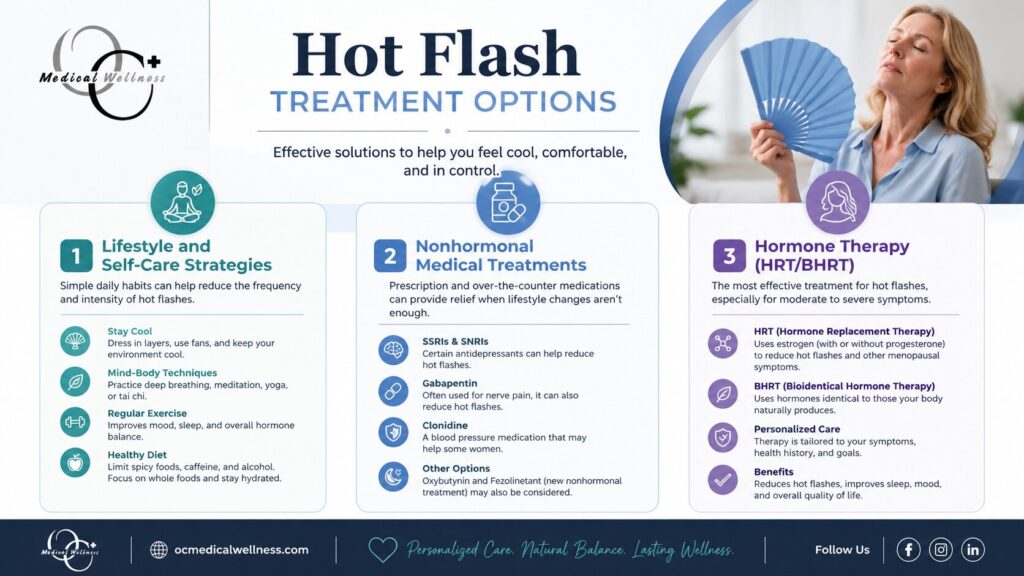
1. Lifestyle and Self-Care Strategies
For mild to moderate hot flashes, lifestyle adjustments are often the first line of defense:
- Dress in layers you can remove quickly when a flash starts
- Keep a portable fan at your desk, in your bag, or on your nightstand
- Lower your bedroom temperature and use moisture-wicking bedding
- Limit common triggers like caffeine, alcohol, and spicy foods
- Maintain a healthy weight, since higher BMI is associated with more frequent, more severe hot flashes
- Quit smoking, which is one of the most consistently documented hot flash triggers
- Try mind-body practices like paced breathing, mindfulness meditation, or cognitive behavioral therapy, which have early-stage evidence supporting symptom reduction
2. Nonhormonal Medical Treatments
For women who can’t or prefer not to take hormones, several FDA-approved and off-label medication options exist:
- Fezolinetant (Veozah) — a neurokinin 3 (NK3) receptor antagonist approved specifically for moderate to severe menopausal hot flashes; it works directly on the brain’s temperature-regulating center
- Low-dose SSRIs/SNRIs, such as paroxetine (Brisdelle), the only antidepressant specifically FDA-approved for hot flashes, typically prescribed at a lower dose than for depression
- Gabapentin, sometimes prescribed off-label, particularly helpful for night sweats
- Clonidine, a blood pressure medication occasionally used off-label for hot flash relief
3. Hormone Therapy (HRT/BHRT)
For many women with moderate to severe symptoms, hormone therapy remains the most effective treatment available. By replenishing estrogen, and progesterone, if you still have a uterus, hormone therapy helps stabilize the hypothalamus’s temperature response, often reducing hot flash frequency and severity significantly. It can also help with related symptoms like vaginal dryness, disrupted sleep, and bone density loss.
This is where bioidentical hormone replacement therapy (BHRT) comes in. Unlike older synthetic hormone formulations, bioidentical hormones are structurally identical to the hormones your body naturally produces, which allows for more precise, individualized dosing based on your actual lab results rather than a one-size-fits-all prescription.
At OC Medical Wellness, Dr. Arturo Portales and our clinical team build every hormone therapy plan around your bloodwork, symptom history, and personal risk factors, not a generic protocol. If you want to understand the different delivery methods and formulations available, our earlier guide on the different types of Hormone Replacement Therapy breaks down pills, patches, creams, and pellet therapy in detail.
Worth noting: Hormone therapy does carry risks, including a higher chance of blood clots, stroke, and certain cancers in some populations, and it isn’t appropriate for everyone. Research since the original 2002 Women’s Health Initiative study has clarified that younger, recently menopausal women generally face a more favorable risk-benefit balance than was first reported. This is exactly why hormone therapy should always be guided by a physician who reviews your full medical history rather than started on your own.
Treatment Comparison at a Glance
| Approach | Best For | Considerations |
| Lifestyle changes | Mild, occasional hot flashes | Free, low-risk, often not enough alone for moderate/severe symptoms |
| Nonhormonal medication | Women who can’t or prefer not to use hormones | Requires prescription; effectiveness varies by individual |
| BHRT / Hormone therapy | Moderate to severe symptoms significantly affecting quality of life | Most effective option for many women; requires medical evaluation and monitoring |
| Unproven supplements (black cohosh, DHEA, soy isoflavones) | — | Not consistently proven effective; some carry safety risks and should never be started without medical guidance |
What About “Natural” Remedies?
It’s worth addressing directly: black cohosh, DHEA, and soy isoflavones are heavily marketed for hot flash relief, but the clinical evidence behind them is inconsistent at best. Phytoestrogens (plant-based compounds that mimic estrogen, found in soy and some legumes) have not been reliably shown to outperform placebo in research, and some supplements carry real risks, including potential liver effects. If you’re drawn to a more natural approach, the better-supported path is a personalized functional medicine evaluation that identifies your actual hormonal and metabolic picture, rather than guessing with an unregulated supplement.
Living With Hot Flashes: Practical Day-to-Day Tips
- Keep a simple symptom log for two weeks, note the time of day, what you were doing, and what you’d eaten or drunk beforehand. Patterns often emerge quickly.
- Choose breathable, natural fabrics like cotton or moisture-wicking athletic wear over synthetic blends.
- If night sweats are disrupting sleep, try cooling pillows or a bedside fan before assuming you need medication.
- Talk with your employer or workspace about small accommodations, like desk fans or flexible dress code, if hot flashes affect your workday.
- Don’t isolate the symptom, hot flashes often travel alongside mood changes, sleep disruption, and low energy, all of which respond well to a coordinated treatment plan rather than being addressed one at a time.
Ready to stop guessing and start treating the actual cause? Hot flashes don’t have to be something you simply endure for the next seven-plus years. Our team at OC Medical Wellness offers comprehensive hormone testing and personalized Hormone Replacement Therapy and wellness care right here in Irvine, built around your bloodwork and your goals, not a generic prescription pad. Schedule a consultation with our team to find out which treatment path fits your body and your life.
Frequently Asked Questions
How long do hot flashes typically last?
Individual episodes usually last one to five minutes, but the overall symptom period is much longer, most women experience hot flashes for more than seven years, and some continue having them for a decade or more after menopause begins.
Can hot flashes happen before menopause actually starts?
Yes. Hot flashes commonly begin during perimenopause, the transitional years before periods stop completely, when estrogen levels start to fluctuate rather than decline steadily.
Is hormone therapy safe for hot flashes?
For many women, especially those under 60 or within 10 years of menopause onset, hormone therapy’s benefits often outweigh its risks. However, it isn’t right for everyone, women with a history of certain cancers, blood clots, or cardiovascular disease need an individualized risk assessment with a physician before starting treatment.
Do men get hot flashes?
Yes. Men can experience hot flashes related to low testosterone or as a side effect of androgen deprivation therapy used in prostate cancer treatment.
What foods or habits make hot flashes worse?
The most commonly reported triggers are caffeine, alcohol, spicy foods, hot beverages, warm environments, and stress. Triggers are individual, so tracking your own pattern is more useful than following a generic list.
Can losing weight help reduce hot flashes?
For many women, yes. Higher body weight is associated with more frequent and severe hot flashes, and research suggests that weight management can meaningfully reduce symptom burden for some individuals.
This article is for educational purposes and isn’t a substitute for personalized medical advice. If you’re experiencing hot flashes that affect your daily life, connect with the team at OC Medical Wellness, led by Dr. Arturo Portales, for a full evaluation and a treatment plan built around your own hormone levels and health history.