
Men who train consistently eventually look for ways to push past a plateau, faster recovery, better body composition, more consistent lean muscle gains. Peptide therapy comes up often in that search, especially among athletes and serious gym-goers looking for a physiological edge grounded in hormone optimization rather than guesswork.
But how much of the hype holds up? What do growth hormone peptides actually do in the body, and what should men understand about safety and regulation before considering them? This guide breaks down the science, the most-discussed compounds, and what a physician-supervised approach to peptide therapy looks like in practice.
What Peptides Actually Are
Peptides are short chains of amino acids, the same building blocks that make up proteins, just far shorter and structurally simpler. Despite their size, peptides function as signaling molecules and hormone regulators throughout the body, influencing metabolism, tissue repair, immune response, and hormone production. Some communicate directly with the brain and endocrine system; others act locally in digestive or immune pathways.
Synthetic peptides are lab-created to mimic or enhance these natural signaling effects, engineered to target specific receptors or biological functions. That precision is what makes them valuable in clinical medicine and research, and also why safety and regulatory status vary enormously from one peptide to the next.
How Peptides May Support Muscle Recovery and Lean Mass
Much of the interest in peptide therapy for fitness centers on the growth hormone (GH) and IGF-1 pathways, both central to cell growth, tissue repair, and protein synthesis.
Growth Hormone Secretagogues (GHS) and GHRH analogs are designed to stimulate the pituitary gland’s own GH output, rather than supplying growth hormone directly. In practice, this class of peptides may support:
- Natural GH and IGF-1 production that drives protein synthesis and muscle repair
- Faster recovery after intense training through improved tissue regeneration
- Better sleep quality, a period when the body releases the bulk of its natural growth hormone
- Improved workout endurance and shorter recovery windows between sessions
The research here is real but still developing. Not every peptide marketed for muscle maintenance has strong human trial data behind it, which is exactly why medical guidance matters before starting any protocol.
A Look at Commonly Discussed Peptides
| Peptide | Mechanism | Potential Benefits | Known Risks | Regulatory Status |
|---|---|---|---|---|
| CJC-1295 (± DAC) | GHRH analog stimulating GH release | May support lean muscle and recovery | Water retention, fatigue, elevated GH | Not FDA-approved for lean mass use |
| Ipamorelin | Selective GH-releasing peptide | Raises GH without significant cortisol/prolactin impact | Headaches, nausea, joint discomfort | Experimental, not FDA-approved |
| GHRP-6 / GHRP-2 | Stimulates GH via ghrelin receptors | May boost GH and appetite; used for recovery | Increased hunger, insulin resistance, fluid retention | Not FDA-approved |
| Tesamorelin | GHRH analog | Reduces visceral fat, raises IGF-1 | Injection-site redness, joint pain, elevated glucose | FDA-approved for a specific indication only |
| BPC-157 | Gastric protein-derived fragment | Tissue healing and recovery support in animal studies | Limited human data, possible vascular effects | Experimental, not FDA-approved |
| TB-500 (Thymosin Beta-4) | Supports tissue regeneration | May aid soft-tissue injury recovery | Unknown long-term safety, injection-site irritation | Experimental, not FDA-approved |
| Sermorelin | GHRH-pathway GH stimulator | Hormone balance, energy, recovery support | Mild injection-site redness, temporary flushing | FDA-approved for GH deficiency |
| PT-141 (Bremelanotide) | Melanocortin receptor agonist | Supports libido and sexual function | Nausea, flushing, headache | FDA-approved for a specific indication |
The regulatory gap matters here: most peptides circulating in the fitness and bodybuilding community, sourced online or from unauthorized suppliers are unregulated research chemicals, not approved therapeutics. Products from those channels carry real risk of contamination, mislabeling, or inconsistent dosing.
Risks and Safety Concerns With Unregulated Peptides
Peptide therapy sounds like a shortcut, but unsupervised or unregulated use carries genuine risk:
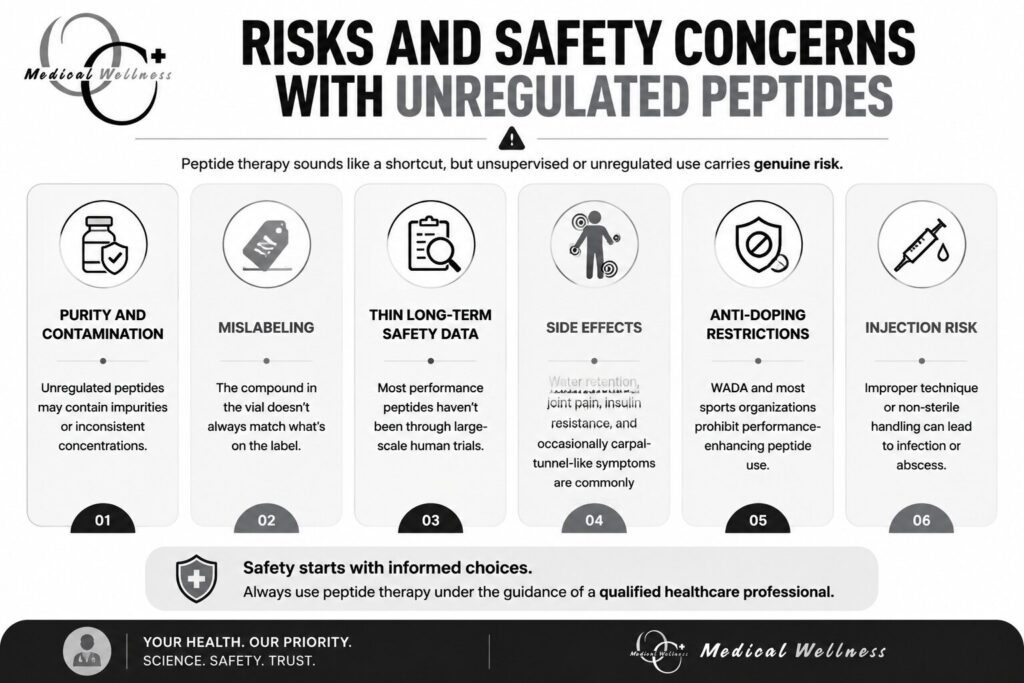
- Purity and contamination — unregulated peptides may contain impurities or inconsistent concentrations
- Mislabeling — the compound in the vial doesn’t always match what’s on the label
- Thin long-term safety data — most performance peptides haven’t been through large-scale human trials
- Side effects — water retention, joint pain, insulin resistance, and occasionally carpal-tunnel-like symptoms are commonly reported
- Anti-doping restrictions — WADA and most sports organizations prohibit performance-enhancing peptide use
- Injection risk — improper technique or non-sterile handling can lead to infection or abscess
Peptide therapy should always run through a licensed provider, not a research-chemical vendor, precisely because these risks scale up fast without medical oversight.
What Actually Drives Muscle Maintenance
Peptides, even the well-studied ones, aren’t a substitute for fundamentals. The core drivers of lean muscle maintenance and recovery remain:
- Consistent resistance training built around progressive overload
- Adequate protein intake to fuel repair and synthesis
- Enough quality sleep to support natural hormone production
- A nutrient-dense diet that supports energy and recovery
When those fundamentals are solid, physician-supervised peptide therapy can complement, not replace, the body’s natural recovery and hormone-optimization processes. Tracking results through body composition scans, performance metrics, and lab work gives a far more reliable picture than how someone looks in the mirror.
Questions Worth Asking Before Starting Peptide Therapy
- What peer-reviewed, human safety and efficacy data exists for this specific peptide?
- What are the known side effects and contraindications?
- Is it compounded through a licensed, GMP-certified pharmacy?
- Does the prescribing clinician have direct experience with peptide protocols?
- How will your progress and safety be monitored over time?
If you can’t get a straight answer to these from wherever you’re sourcing a peptide, that’s a signal to step back.
How OC Medical Wellness Approaches Peptide Therapy
At OC Medical Wellness in Irvine, peptide protocols are built around individualized biomarkers, health history, and treatment goals, not a one-size-fits-all menu. Every plan starts with baseline labs, uses peptides selected for a documented clinical need, and includes scheduled follow-up to confirm the protocol is working and adjust dosing as needed.
Rather than chasing experimental compounds with thin safety data, the focus stays on evidence-based, physician-guided hormone optimization, supporting the body’s natural recovery and metabolic pathways rather than trying to override them with unregulated research chemicals.
If you’re training hard and want to know whether medically supervised peptide therapy makes sense for your recovery and performance goals, schedule a consultation with OC Medical Wellness to review your labs and options directly.