
A Long Term Acute Care (LTAC) facility, also called a Long Term Acute Care Hospital (LTACH), is a specialized hospital designed to treat patients with serious, complex medical conditions who require an extended acute care stay, typically averaging 25 days or more.
Unlike a traditional short-stay hospital focused on stabilizing patients and discharging them quickly, LTAC facilities provide ongoing, intensive medical treatment for patients who are medically stable enough to leave an ICU but still too dependent on complex interventions to be safely managed in a skilled nursing facility or rehabilitation center.
Read More: What Is Acute Care?
Key distinction: LTAC facilities are certified by the Centers for Medicare & Medicaid Services (CMS) as acute care hospitals. This is not a nursing home or step-down unit, it is a licensed, stand-alone hospital with an average length of stay exceeding 25 days.
A Brief History
LTAC hospitals emerged as a formal category in the U.S. healthcare system in the 1980s following the introduction of the Medicare prospective payment system (PPS). As traditional hospitals came under pressure to discharge patients faster, a need arose for facilities that could handle patients requiring extended acute care. CMS formally recognized LTACHs as a distinct provider type, granting them an exception to the standard DRG payment model.
| Statistic | Details |
|---|---|
| 25+ | Average days per stay (CMS minimum) |
| 400+ | LTAC hospitals in the U.S. |
| ~60% | Patients requiring mechanical ventilation |
| 5:1 | Typical patient-to-nurse ratio |
Who Needs Long Term Acute Care?
LTAC facilities serve a specific and often critically ill patient population. The majority of admissions come directly from ICUs, medical/surgical units, or hospital step-down units. Understanding if a patient is a candidate requires understanding the clinical profile these hospitals are built to manage.
Common Conditions Treated in LTAC Facilities
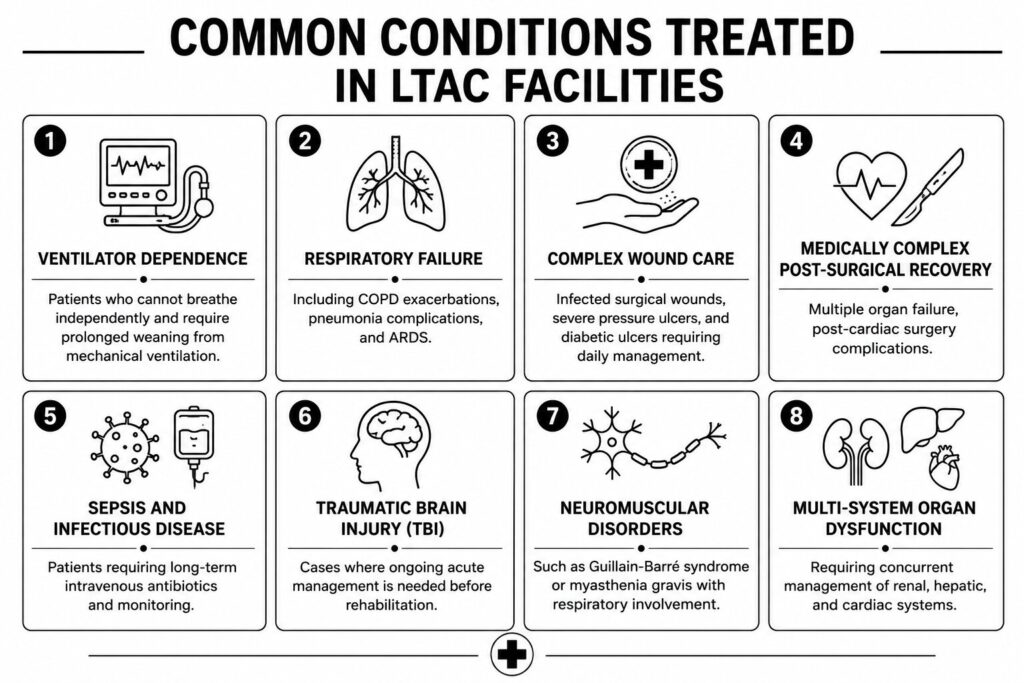
- Ventilator dependence: Patients who cannot breathe independently and require prolonged weaning from mechanical ventilation
- Respiratory failure: Including COPD exacerbations, pneumonia complications, and ARDS
- Complex wound care: Infected surgical wounds, severe pressure ulcers, and diabetic ulcers requiring daily management
- Medically complex post-surgical recovery: Multiple organ failure, post-cardiac surgery complications
- Sepsis and infectious disease: Patients requiring long-term intravenous antibiotics and monitoring
- Traumatic brain injury (TBI): Cases where ongoing acute management is needed before rehabilitation
- Neuromuscular disorders: Such as Guillain-Barré syndrome or myasthenia gravis with respiratory involvement
- Multi-system organ dysfunction: Requiring concurrent management of renal, hepatic, and cardiac systems
Who Is NOT a Typical LTAC Candidate?
LTAC care is not appropriate for every patient. Individuals who are medically stable and primarily need physical or occupational therapy are generally better served by Inpatient Rehabilitation Facilities (IRFs). Similarly, patients who need basic custodial or skilled nursing care belong in Skilled Nursing Facilities (SNFs).
Caregiver tip: If you’re told your loved one needs to “go somewhere” after a hospital stay but their condition still feels serious and unstable, ask specifically: “Would they qualify for an LTAC hospital?” Many families don’t know to ask, but discharge planners and case managers can help assess eligibility.
LTAC vs. Other Care Settings: A Clear Comparison
One of the most confusing aspects of post-acute care is understanding how different facility types relate to each other. Here’s a direct comparison across the most important dimensions:
| Feature | LTAC Hospital | ICU / Acute Hospital | Skilled Nursing Facility (SNF) | Inpatient Rehab (IRF) |
|---|---|---|---|---|
| Avg. length of stay | 25–45 days | 3–7 days | 20–35 days | 12–15 days |
| Medical intensity | High | Very high | Low to moderate | Moderate |
| Nurse-patient ratio | ~1:4–1:6 | ~1:1–1:2 | ~1:10–1:20 | ~1:5–1:7 |
| Ventilator weaning | Yes | Yes | Limited | No |
| Wound management | Advanced | Advanced | Basic to moderate | Basic |
| Primary goal | Medically complex recovery | Stabilization | Custodial + skilled care | Functional rehabilitation |
| Medicare certification | Acute care hospital | Acute care hospital | SNF benefit | IRF benefit |
LTAC vs. Skilled Nursing Facility: The Critical Difference
This is the comparison families most often get wrong. Both settings provide extended care after a hospital stay, but they operate at fundamentally different levels of medical complexity. A skilled nursing facility is not equipped to manage patients on mechanical ventilators or those requiring daily physician oversight for unstable, life-threatening conditions. Placing a medically complex patient in an SNF when they need LTAC care can result in rapid deterioration and costly hospital readmissions.
Read More: What Is an Acute Care Hospital?
Services and Treatments Provided at LTAC Facilities
LTAC hospitals must maintain the full clinical infrastructure of an acute care hospital, even though their patients stay much longer. This means robust physician coverage, diagnostic capabilities, and specialty services.
Core Clinical Services
Post-surgical management and complication treatment
- Mechanical ventilation management and weaning programs
- IV antibiotic therapy and infectious disease management
- Dialysis (on-site or bedside) for renal failure patients
- Total parenteral nutrition (TPN) and enteral feeding
- Wound care, including hyperbaric oxygen therapy at select facilities
- Cardiac monitoring and telemetry
- Pulmonary therapy and respiratory care
Therapy and Rehabilitation Services
While LTAC facilities are not primarily rehabilitation hospitals, nearly all offer integrated therapy services to maintain and improve function during the extended stay:
- Physical therapy (PT): mobility, strength, and fall prevention
- Occupational therapy (OT): activities of daily living, fine motor recovery
- Speech-language pathology (SLP): swallowing disorders (dysphagia), communication after intubation
- Respiratory therapy: breathing exercises, ventilator management
Specialty Physician Coverage
LTAC hospitals are required to have physician oversight. Most employ or contract with hospitalists, intensivists, pulmonologists, and other specialists. Daily rounding by physicians, not just nursing staff is a defining feature that separates LTACs from SNFs.
Typical specialist involvement includes:
- Pulmonology / Critical care medicine
- Nephrology (kidney disease)
- Cardiology
- Infectious disease
- Wound care specialists / plastic surgery
- Psychiatry for ICU-related mental health complications
Cost and Insurance Coverage
How Much Does LTAC Care Cost?
LTAC care is expensive, typically ranging from $1,500 to $3,500 per day, depending on the facility, location, and complexity of care required. A standard 30-day stay can cost $45,000 to $105,000 or more without insurance coverage.
Medicare Coverage for LTAC Facilities
Medicare Part A covers LTAC hospital stays under a separate prospective payment system (LTACH PPS), meaning LTAC hospitals receive a fixed payment per discharge rather than per day. To qualify for Medicare coverage at an LTACH, patients must meet specific criteria:
- The patient must have a qualifying 3-day inpatient hospital stay immediately prior
- The patient’s clinical complexity must meet Medicare’s criteria for LTACH-level care
- The facility must be CMS-certified as an LTACH
Important 2026 note: Medicare’s “25-day rule” requires that the average Medicare inpatient length of stay at an LTACH must exceed 25 days. Individual patients may have shorter stays, but the facility-wide average must meet this threshold to maintain LTACH certification.
Medicaid and Private Insurance
Medicaid coverage for LTAC care varies significantly by state. Many state Medicaid programs do cover LTACH stays, but prior authorization is typically required and benefit limits apply. Private insurance plans may cover LTAC care as well, but patients should verify that the specific facility is in-network before transfer to avoid surprise billing.
Coverage Checklist Before Transfer:
- Confirm the LTAC facility accepts your insurance
- Request a pre-authorization from your insurer
- Ask about your deductible and out-of-pocket maximum
- Clarify the daily copayment structure for extended stays
- Discuss financial assistance programs directly with the LTAC’s billing department
How to Choose the Right LTAC Facility
Not all LTAC hospitals are created equal. Quality varies meaningfully, and the right choice can affect recovery outcomes, length of stay, and the likelihood of returning home rather than being discharged to another facility.
Key Quality Indicators to Evaluate
- CMS star rating: Check the facility’s rating on Medicare’s Care Compare tool
- Ventilator weaning success rate: Ask what percentage of ventilator-dependent patients are successfully weaned
- Discharge-to-home rates: A higher rate of patients discharged home (vs. SNF or back to acute hospital) is a positive sign
- Hospital readmission rates: Lower is better; high readmission suggests inadequate clinical management
- Specialist availability: Are the specialists you need (pulmonology, nephrology, wound care) available on-site?
- Infection rates: Ask about MRSA, C. difficile, and CAUTI (catheter-associated urinary tract infections) rates
- Family visitation policies: Open visitation hours significantly benefit recovery in long-stay patients
Questions to Ask Before Choosing an LTAC Facility
Before selecting a facility, ask:
- What medical services are available?
- How often do physicians evaluate patients?
- What rehabilitation therapies are provided?
- What are the visiting policies?
- Does insurance cover treatment?
- What discharge planning services are offered?
What to Expect: Outcomes and Discharge Planning
Realistic Outcome Expectations
Outcomes in LTAC care depend heavily on the patient’s underlying diagnosis, age, functional baseline before illness, and comorbidities. For ventilator-dependent patients, successful weaning rates range from 40–70% at high-quality LTAC hospitals. Many patients do make significant progress and are discharged to rehabilitation facilities or even home with support services.
However, LTAC patients are among the most medically complex in the entire healthcare system. Families should be prepared for a non-linear recovery, setbacks are common, and discharge timelines are often longer than initially anticipated.
The Discharge Planning Process
Every LTAC patient should have an interdisciplinary care team actively working on a discharge plan from day one. This typically involves:
- A case manager or social worker coordinating next-level care
- Weekly family care conferences to review goals and progress
- Assessment of home support needs (home health aides, home ventilator programs, DME)
- Coordination with the patient’s outpatient physicians for continuity of care
FAQs
What is the difference between a long term acute care facility and a nursing home?
An LTAC is a Medicare-certified acute care hospital for medically complex patients needing intensive treatment and long stays. A nursing home provides basic care for stable patients and cannot manage critical conditions like ventilators or multi-organ failure.
Does Medicare cover long term acute care hospital stays?
Yes. Medicare Part A covers LTAC stays if a patient has a prior 3-day hospital stay and meets criteria. After the deductible, the first 60 days are covered, with copays after. Approval requires documented medical necessity.
How long can a patient stay in a long term acute care facility?
There’s no fixed stay limit at an LTAC. Medicare requires an average stay over 25 days, but individual stays vary. Coverage continues while acute care is needed.
Who decides if a patient should go to an LTAC facility?
The decision is made by the physician, case manager, and patient or family. The physician must confirm the need for ongoing acute care, and the LTAC facility reviews eligibility before transfer. Patients and families should be involved and can ask questions about the recommendation.
What is the survival rate for patients in LTAC facilities?
Survival rates vary by condition, with LTAC in-hospital mortality typically ranging from 15% to 35%. Rates may be higher for ventilated patients, but outcomes have improved with better weaning, infection control, and rehabilitation. Facility-specific data is available through CMS Care Compare or directly from providers.
Key Takeaways
- LTAC facilities are Medicare-certified acute care hospitals for patients with complex, long-duration medical needs
- They fill the critical gap between ICU care and lower-acuity settings like SNFs or rehab hospitals
- Average stay exceeds 25 days; physician-led care and hospital-level services are core features
- Medicare Part A covers LTAC stays with a qualifying prior hospitalization
- Quality varies widely, always evaluate ventilator weaning rates, readmission rates, and CMS ratings before choosing
- Discharge planning should begin on day one, with clear goals and family communication throughout
Navigating the next step in care?
At OC Medical Wellness, we understand that choosing the right long-term acute care solution is an important decision for patients and families. Whether you’re transitioning from a hospital stay or exploring extended recovery options, our experienced team is committed to providing compassionate guidance, advanced medical support, and personalized care every step of the way.
Have questions about long-term acute care services? Contact OC Medical Wellness today to learn how we can support your recovery journey with trusted, patient-centered care.