
Morpheus8 is considered safe for most healthy adults when performed by a trained medical provider. It carries FDA clearance for skin remodeling and soft tissue contraction, and its most common side effects, redness, swelling, and mild discomfort, are temporary and resolve within a few days. Serious complications are rare but possible, and understanding them ahead of time helps you recover faster and get better results.
If you’re weighing Morpheus8 in Irvine against other skin tightening options, this guide breaks down exactly what happens to your skin during and after treatment, which side effects are normal, which ones warrant a call to your provider, and how to plan your recovery around it.
What Is Morpheus8?
Morpheus8 is a fractional radiofrequency (RF) microneedling device manufactured by InMode. It combines microneedling with RF energy delivered through insulated needles that penetrate up to 4mm into the skin, heating the deeper dermal and subdermal layers to stimulate collagen and elastin production while remodeling fat and tightening loose tissue. It’s FDA cleared for skin resurfacing and, as of a 2024 clearance update, for soft tissue contraction as well.
Unlike surface-level lasers, Morpheus8 works beneath the skin, which is why it’s commonly used for jowls, sagging skin along the jawline and neck, acne scarring, and stretch marks, on the face and body, and across most skin tones.
Is Morpheus8 Safe?
Yes. Clinical research on radiofrequency microneedling describes it as a relatively safe procedure with a low rate of serious adverse events when performed correctly. A systematic review of microneedling studies covering more than 1,000 patients found that the most frequently reported effects were expected, mild reactions like redness, swelling, and short-term skin irritation rather than lasting damage.
Safety with Morpheus8 depends heavily on three factors:
- Provider training. RF energy settings need to be adjusted for skin type, treatment area, and depth. Under- or over-treatment increases the risk of burns, uneven results, or prolonged healing.
- Patient screening. Certain health conditions and medications increase risk and should be reviewed during a consultation before treatment.
- Aftercare compliance. Sun exposure, skincare products, and activity level in the days following treatment all affect how the skin heals.
At OC Medical Wellness, Morpheus8 treatments are performed under medical supervision with a consultation beforehand to confirm you’re a good candidate.
Common Morpheus8 Side Effects
These are expected, short-term reactions that the vast majority of patients experience to some degree. They’re a normal part of how the treatment triggers your skin’s healing response, not a sign that something has gone wrong.
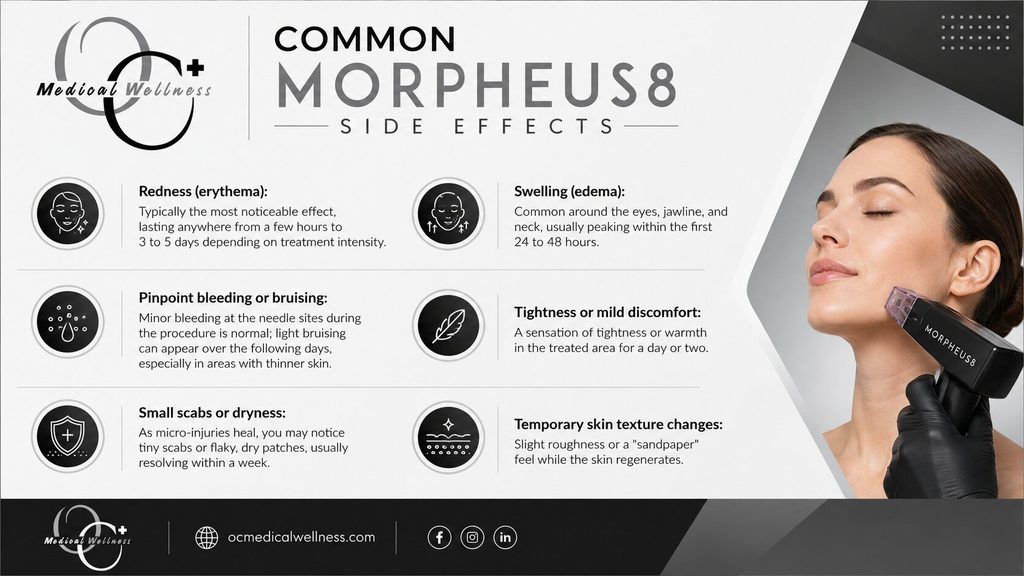
- Redness (erythema): Typically the most noticeable effect, lasting anywhere from a few hours to 3 to 5 days depending on treatment intensity.
- Swelling (edema): Common around the eyes, jawline, and neck, usually peaking within the first 24 to 48 hours.
- Pinpoint bleeding or bruising: Minor bleeding at the needle sites during the procedure is normal; light bruising can appear over the following days, especially in areas with thinner skin.
- Tightness or mild discomfort: A sensation of tightness or warmth in the treated area for a day or two.
- Small scabs or dryness: As micro-injuries heal, you may notice tiny scabs or flaky, dry patches, usually resolving within a week.
- Temporary skin texture changes: Slight roughness or a “sandpaper” feel while the skin regenerates.
Rare but Possible Risks
Serious complications are uncommon with Morpheus8, but patients should understand them before treatment.
- Burns or blistering: Can occur if RF energy settings are too high for the treatment area or skin type, or if aftercare instructions aren’t followed.
- Hyperpigmentation or hypopigmentation: Temporary or, rarely, longer-lasting changes in skin color, more likely in patients with darker skin tones or with insufficient sun protection during healing.
- Infection: Uncommon when proper sterile technique is used, but any break in the skin barrier carries some risk.
- Prolonged redness or swelling: In a small number of cases, these effects last longer than a week.
- Scarring: Rare, and more likely if the skin is picked at, scratched, or exposed to excess sun during recovery.
- Numbness or altered sensation: Occasionally reported near treatment sites, usually temporary.
Choosing an experienced provider and disclosing your full medical history are the two biggest factors in avoiding these outcomes.
Who Should Avoid Morpheus8?
Morpheus8 isn’t recommended for everyone. You may need to skip or postpone treatment if you:
- Are pregnant or breastfeeding
- Have an active skin infection, cold sore, or open wound in the treatment area
- Have a pacemaker or other implanted electronic medical device
- Have uncontrolled diabetes or an autoimmune condition affecting wound healing
- Are taking blood thinners, or medications that increase sun sensitivity or bleeding risk
- Have a history of keloid scarring
- Have recently used isotretinoin (Accutane), typically within 6 months
This isn’t an exhaustive list. A consultation with your provider is the best way to confirm whether Morpheus8 is appropriate for your specific health history. If your primary concern is hormonal or metabolic, it’s also worth reviewing it with your care team since factors like hormone imbalance can affect skin quality and healing independent of any aesthetic treatment.
Morpheus8 Recovery Timeline
| Timeframe | What to Expect |
|---|---|
| Day 0 (treatment day) | Redness, warmth, mild swelling; skin may look flushed like a sunburn |
| Days 1 to 2 | Swelling typically peaks, especially around the eyes and jaw |
| Days 2 to 4 | Redness fades to pink; small scabs or dry patches may appear |
| Days 5 to 7 | Most visible redness resolves; skin texture starts to normalize |
| Weeks 2 to 3 | Skin appears normal day-to-day; early collagen remodeling begins |
| Months 1 to 3 | Progressive improvement in tightness, texture, and tone as collagen rebuilds |
Most patients return to normal activities within 24 to 48 hours, and makeup can usually be worn again within a day or two once any pinpoint marks have closed. Full results build gradually over 4 to 12 weeks, with continued improvement for up to three months.
How to Minimize Side Effects: Aftercare Tips
Following aftercare instructions closely is the single most effective way to reduce side effects and support a smooth recovery.
- Avoid direct sun exposure for at least a week, and wear a broad-spectrum sunscreen once your provider clears you to apply it.
- Skip makeup for 24 to 48 hours to reduce infection risk while the skin is healing.
- Avoid strenuous exercise, saunas, and hot showers for the first 24 to 48 hours to keep swelling and heat exposure down.
- Don’t pick at scabs or flaking skin, which increases the risk of scarring and pigmentation changes.
- Use gentle, fragrance-free skincare and hold off on retinoids or exfoliating acids until your provider says it’s safe. If you’re not sure which products are compatible with your recovery, ask about clinically appropriate options through medical-grade skincare.
- Stay hydrated to support tissue repair.
- Keep follow-up appointments so your provider can monitor healing and address any concerns early.
Morpheus8 vs. Other Skin Tightening Treatments
Morpheus8 is one of several energy-based options for skin laxity, and it isn’t always the right fit for every patient or concern.
| Treatment | How It Works | Best For | Typical Downtime |
|---|---|---|---|
| Morpheus8 | RF energy delivered via microneedles into the deep dermis and subdermal fat | Moderate skin laxity, acne scars, jowls, body contouring | 2 to 5 days |
| Ultherapy | Focused ultrasound energy targeting deeper tissue layers without breaking the skin | Mild to moderate sagging, brow and jawline lifting | Minimal to none |
| NuEra RF (nonsurgical skin tightening) | Non-invasive RF heating without needles | Mild laxity, general skin tightening, no downtime preference | Minimal to none |
| Laser skin resurfacing | Laser energy targeting the skin’s surface and texture | Sun damage, fine lines, texture and tone concerns | Varies by laser intensity |
Because Morpheus8 penetrates deeper than non-needling RF devices, it tends to deliver more noticeable tightening for moderate laxity, but it also comes with more downtime than a no-needle option like NuEra RF. Your provider can help you weigh those trade-offs based on your goals and skin concerns during a consultation.
What to Expect at OC Medical Wellness
At OC Medical Wellness in Irvine, Morpheus8 treatments begin with a consultation to review your medical history, skin goals, and any contraindications before a treatment plan is created. Topical numbing is applied before the procedure to keep discomfort manageable, and most sessions take 30 to 60 minutes depending on the treatment area. Patients in Irvine and across Orange County typically complete a series of 3 sessions spaced several weeks apart for optimal results, with annual touch-ups thereafter.
If you’re also managing broader wellness goals, whether that’s weight loss or functional medicine support, OC Medical Wellness coordinates aesthetic treatments alongside your overall care plan rather than treating skin concerns in isolation.
Frequently Asked Questions
Is Morpheus8 painful?
Most patients describe it as a deep heat or pressure sensation rather than sharp pain, especially with topical numbing applied beforehand. Discomfort levels vary by treatment area and depth setting.
How long does swelling last after Morpheus8?
Swelling usually peaks within the first 24 to 48 hours and resolves substantially within a week, though it can linger longer around the eyes.
Can Morpheus8 cause scarring?
Scarring is rare when the procedure is performed correctly and aftercare instructions are followed. Risk increases with picking at the skin, excessive sun exposure, or a history of keloid scarring.
How many Morpheus8 treatments do I need?
Most providers recommend a series of 3 sessions spaced 4 to 6 weeks apart, followed by annual maintenance treatments.
Is Morpheus8 safe for darker skin tones?
Yes. Because RF energy, rather than light-based energy, drives the treatment, Morpheus8 carries a lower risk of post-inflammatory hyperpigmentation than many laser treatments, making it a commonly used option across a range of skin tones.
When will I see results after Morpheus8?
Initial improvement can appear within a few weeks, with continued collagen remodeling and visible tightening over 4 to 12 weeks, and results building for up to 3 months.
Is Morpheus8 worth it?
For patients with moderate skin laxity, acne scarring, or early jowling who want more than a topical or non-invasive option provides, Morpheus8 offers a middle ground between no-downtime treatments and surgical procedures. Whether it’s worth it depends on your specific goals, skin concerns, and tolerance for a few days of downtime, which is best discussed during a consultation.
Key Takeaways
- Morpheus8 is FDA cleared and considered safe for most healthy adults when performed by a trained provider.
- Common side effects, redness, swelling, and mild discomfort, are temporary and typically resolve within a week.
- Serious risks like burns, infection, or pigmentation changes are rare and are minimized through proper provider training and aftercare.
- Recovery is generally short, with most patients resuming normal activities within 24 to 48 hours.
- A pre-treatment consultation is the best way to confirm candidacy and reduce risk based on your health history.
- Full results develop gradually over 1 to 3 months as new collagen forms.
Ready to Learn if Morpheus8 Is Right for You?
If you’re considering Morpheus8 for skin tightening, acne scarring, or facial rejuvenation, the safest first step is a consultation with a provider who can evaluate your skin and health history in person. Schedule a consultation with OC Medical Wellness in Irvine to discuss your goals and find out whether Morpheus8, or another treatment option, is the right fit for you.