
When a medical emergency strikes or a sudden illness flares up, the terms “acute care” and “critical care” often get used interchangeably, but they describe very different levels of treatment. Understanding the distinction matters, whether you’re navigating a hospital admission for a loved one, choosing the right facility, or simply trying to make sense of a discharge summary.
This guide breaks down the real differences between acute care and critical care, where each is delivered, who provides it, and how to know which level of care fits a given medical situation.
What Is Acute Care?
Acute care is short-term medical treatment for a sudden illness, injury, or flare-up of a chronic condition. The goal is to stabilize the patient, treat the immediate problem, and either discharge them home or transition them to recovery, rehabilitation, or long-term care.
Acute care covers a broad spectrum, including emergency visits, urgent surgeries, hospital admissions for pneumonia or appendicitis, and post-operative recovery. Most hospital stays in the world fall under this category.
Typical features of acute care:
- Short duration (hours to a few weeks)
- Treats a specific, time-limited problem
- Delivered by general physicians, hospitalists, surgeons, and specialized nurses
- Patient is usually conscious, stable, and not at imminent risk of death
Read More about: What Is Acute Care?
What Is Critical Care?
Critical care, sometimes called intensive care, is the highest level of medical treatment for patients with life-threatening conditions. These patients have failing organs, unstable vital signs, or injuries severe enough that without constant monitoring and intervention, they could die within hours.
Critical care happens in a specialized unit, typically the Intensive Care Unit (ICU), Cardiac Care Unit (CCU), or Neuro ICU, where staffing ratios are higher and advanced life-support equipment is standard.
Typical features of critical care:
- High-intensity, 24/7 monitoring
- Often involves mechanical ventilation, dialysis, or vasoactive drugs
- Delivered by intensivists, critical care nurses, respiratory therapists, and specialists
- Patient is frequently unconscious, sedated, or unable to breathe independently
Acute Care vs Critical Care: Side-by-Side Comparison
| Factor | Acute Care | Critical Care |
|---|---|---|
| Patient condition | Stable but ill or injured | Life-threatening, unstable |
| Setting | General hospital ward, ER, urgent care | ICU, CCU, Neuro ICU, Trauma ICU |
| Monitoring | Periodic vitals checks | Continuous monitoring of every organ system |
| Nurse-to-patient ratio | Often 1:4 to 1:6 | Typically 1:1 or 1:2 |
| Equipment | IV lines, oxygen, basic monitors | Ventilators, ECMO, dialysis, arterial lines |
| Average length of stay | 1 to 7 days | Hours to several weeks |
| Lead clinician | Hospitalist or attending physician | Intensivist (critical care specialist) |
| Goal | Treat and discharge | Stabilize and sustain life |
The Continuum: How Patients Move Between the Two
Acute care and critical care aren’t separate worlds. They sit on the same continuum, and patients often move between them during a single hospital stay.
A patient admitted through the emergency department for severe pneumonia, for example, may start in an acute care ward. If their oxygen levels drop and they need a ventilator, they’re transferred to the ICU for critical care. Once stable, they step down to acute care for recovery, then go home.
This flow is why hospitals are designed with escalation pathways. The ability to move a patient up or down the intensity ladder is a core feature of modern hospital medicine.
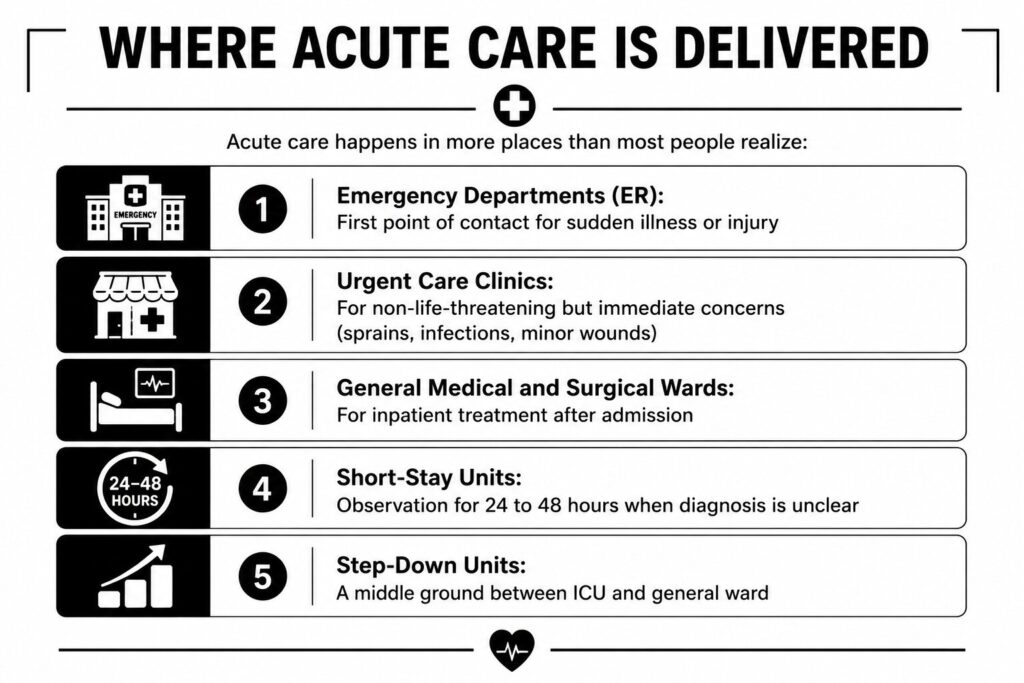
Where Acute Care Is Delivered
Acute care happens in more places than most people realize:
- Emergency departments (ER): First point of contact for sudden illness or injury
- Urgent care clinics: For non-life-threatening but immediate concerns (sprains, infections, minor wounds)
- General medical and surgical wards: For inpatient treatment after admission
- Short-stay units: Observation for 24 to 48 hours when diagnosis is unclear
- Step-down units: A middle ground between ICU and general ward
Where Critical Care Is Delivered
Critical care is concentrated in specialized units within hospitals:
- Medical ICU (MICU): For severe medical conditions like sepsis or respiratory failure
- Surgical ICU (SICU): Post-operative patients with complex needs
- Cardiac Care Unit (CCU): Heart attacks, severe arrhythmias, post-cardiac surgery
- Neuro ICU: Stroke, traumatic brain injury, post-neurosurgery
- Pediatric ICU (PICU) and Neonatal ICU (NICU): For children and newborns
- Trauma ICU: Major injuries from accidents or violence
Who Provides the Care
The clinical teams differ significantly between the two levels.
Acute care teams generally include hospitalists, attending physicians, nurses with medical-surgical training, physical therapists, social workers, and pharmacists. The pace is steady, and decisions are made on a daily round.
Critical care teams are led by intensivists, physicians with additional fellowship training in critical care medicine. They work alongside critical care nurses (often with CCRN certification), respiratory therapists who manage ventilators, clinical pharmacists who fine-tune drug dosing for unstable patients, and specialists like nephrologists or cardiologists as needed. Decisions in the ICU are often made hour by hour, sometimes minute by minute.
Read More: What Is an Acute Care Hospital? Complete Guide for Patients
How to Tell Which Level a Patient Needs
The distinction usually comes down to physiological stability. A useful framework:
A patient needs acute care when they have a clear medical problem that requires hospital-level treatment but their vital signs are stable, they can breathe on their own, and their organs are functioning.
A patient needs critical care when one or more organ systems are failing or at imminent risk of failing, when they need life-support equipment, or when their condition could deteriorate rapidly without constant intervention.
Examples that typically require critical care include septic shock, severe COVID-19 with respiratory failure, major trauma, post-cardiac arrest, acute stroke requiring thrombolysis monitoring, and complicated post-surgical cases.
Cost and Insurance Considerations
Critical care is significantly more expensive than acute care. A single ICU day can cost several times more than a general ward day, driven by equipment, staffing ratios, and medications. Most health insurance plans cover both, but coverage details, copays, and length-of-stay limits vary widely.
If you’re navigating a hospitalization, ask the care team about expected length of stay and whether a step-down unit might be appropriate once the patient stabilizes. This isn’t about cutting corners; it’s about matching care intensity to actual need, which is also better for patient recovery.
Outcomes and Recovery
Patients leaving critical care often face a longer recovery than those who stayed in acute care. Post-Intensive Care Syndrome (PICS) is a recognized condition involving physical weakness, cognitive difficulties, and psychological effects like anxiety or PTSD after an ICU stay.
Acute care recovery is usually more straightforward, focused on healing from the specific illness or procedure. Follow-up typically involves primary care, outpatient rehab, or specialist visits rather than the multidisciplinary support critical care survivors often need.
FAQs
Is critical care the same as intensive care?
Yes, the terms are used interchangeably in most countries. Critical care medicine is the medical specialty, and intensive care unit (ICU) is the most common name for the place where it’s delivered.
Can a patient receive critical care outside the ICU? I
n emergencies, yes. Critical care can begin in the emergency department, during transport, or even on a general ward before transfer. However, sustained critical care requires the equipment and staffing only an ICU provides.
How long do patients typically stay in critical care?
ICU stays vary widely based on the condition. Many patients spend 2 to 5 days in critical care, but those with severe illness like ARDS or major trauma may stay for weeks. Length of stay is one of the strongest predictors of recovery time.
Is acute care only for emergencies?
No. While emergencies are part of acute care, the term covers any short-term treatment for a sudden medical issue, including planned surgeries, infections requiring IV antibiotics, and flare-ups of chronic conditions like asthma or heart failure.
What’s the difference between acute care and long-term care?
Acute care treats short-term, time-limited problems and aims for discharge within days or weeks. Long-term care supports people with ongoing needs, such as those with chronic illness, disability, or age-related decline, often over months or years in settings like nursing homes or skilled nursing facilities.
Do all hospitals offer critical care?
No. Smaller community hospitals may have limited or no ICU capacity and transfer critically ill patients to larger tertiary care centers. This is why ambulance services often bypass closer hospitals for major trauma or stroke cases, going directly to facilities with full critical care capabilities.
Summary:
Acute care and critical care describe different points on the same spectrum of hospital medicine. Acute care handles short-term, stable conditions requiring hospital-level treatment, while critical care manages life-threatening illnesses with continuous monitoring and life-support technology. Patients often move between the two during a single hospital stay, and the level of care matches the severity of their condition at any given moment.
Understanding this distinction helps patients and families make sense of care plans, ask better questions of medical teams, and set realistic expectations for recovery.
Get Expert Acute Care in Irvine, CA, Without the ER Wait
When a sudden illness or injury can’t wait, OC Medical Wellness is here to help. Our Irvine-based team delivers fast, professional acute care treatment in a comfortable setting, so you get back to feeling your best, sooner.
- Same-day appointments available
- Experienced medical professionals
- Personalized, patient-first care
Schedule your visit today your health can’t wait, and neither should you.